
Más Vermú....
From papyrus to happy hour; 3,500 years of wormwood shaken, not stirred.

Picking up from the previous post, some history, and more reviews. The origin story of vermouth is genuinely murky. It stretches back far enough that the line between medicine, ritual, and what we’d recognize as a beverage gets very blurry. The trail here goes back a very long way, and it’s worth tracing properly because vermouth’s prehistory is richer than most people realize.
Despite what Eurocentric wine snobs might tell you, shoving bitter weeds into alcohol is not a European invention. We can thank ancient Egypt for that. The Ebers Papyrus, essentially an Egyptian WebMD dating back to 1550 BCE, shows that they were already using wormwood for both holy rituals and medical complaints. That’s roughly 3,500 years of humans looking at a punishingly bitter plant and deciding, “Yeah, I should put that in my mouth.” Granted, historians aren’t entirely sure if they were steeping it in wine, water, or just vibes, but the Mediterranean obsession with aromatizing alcohol was already well underway.
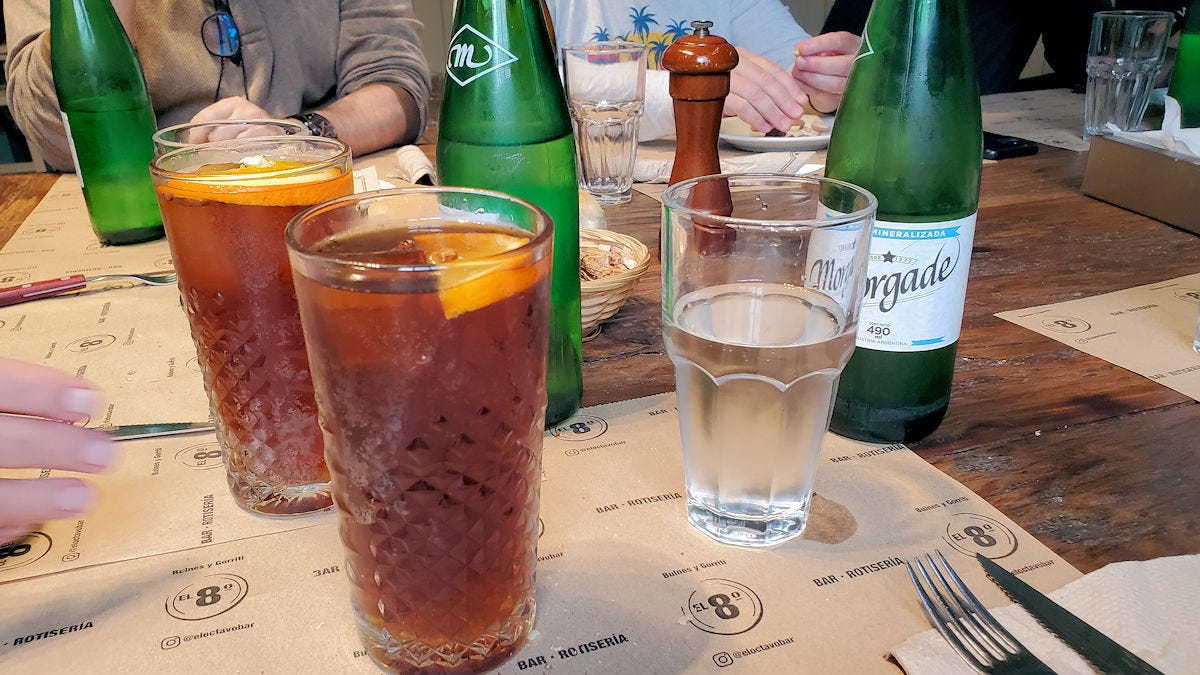
Things get a bit clearer, and much more directly ancestral to your Sunday Negroni, with the ancient Greeks. Around 460 BCE, Hippocrates was busy prescribing wormwood for jaundice and that timeless, catch-all medical category: “women’s troubles.” Later, Dioscorides, the apex pharmacologist of antiquity, went full overachiever and listed 33 distinct uses for the weed. His signature wormwood wine, oinon apsinthiton, was a cure-all for stomach issues, liver failure, intestinal worms, and even eye inflammation. To be entirely clear: this was absolutely not a pleasure drink. These were oinoi hygieinoi (medicinal wines), where the alcohol functioned less as a social lubricant and more as a solvent to dissolve aggressive botanicals. They even filtered out the sludge using a specialized cloth strainer called the “sleeve of Hippocrates.” The ancient Greeks essentially invented a primitive coffee filter just so they could choke down awful-tasting medicine.
The Romans, naturally, took this practice and ran with it. They branded wormwood as a gift from the goddess Diana, convinced it could counteract hemlock poisoning and accidental toadstool consumption, apparently, a recurring issue back then. In a classic display of Roman stoicism, victors of chariot races at the Circus Maximus were forced to drink wormwood wine upon winning. The rationale? A friendly reminder that even when you’re the champion of the empire, life still contains bitterness. Pliny the Elder, never one to miss an opportunity to catalog things, listed four varieties and 48 remedies for it in his Naturalis Historia. Slowly, though, the drink began to edge away from pure punishment and toward actual ritual and celebration.
After the fall of Rome, the recipe book was handed over to the Catholic Church. In the early medieval period, monasteries functioned as the designated drivers of Western civilization, acting as the primary custodians of medical knowledge. Monks grew the herbs, copied the texts, and brewed the herbal wines in deep, institutional secrecy; treating recipes like highly guarded corporate property. While this holy gatekeeping eventually gave us heavy-hitters like Chartreuse and Bénédictine, the direct ancestors of modern vermouth were quietly fermenting in the dark infirmaries of northern Italian and Alpine monasteries.
The pivot from "choke this down for your worms" to "let's have an aperitif before dinner" didn't happen overnight. By the Renaissance, apothecaries were selling herbal tonics that people were suspiciously starting to buy just for the buzz. Enter Antonio Benedetto Carpano in Turin, 1786. Carpano didn’t really invent sweet red vermouth; he just formalized it. He took a two-millennium-old medicinal chore, gave it a consistent recipe, and slapped on a name borrowed from Wermut, the German word Alpine traders used for the plant. Carpano's true genius wasn't the liquid itself; it was the marketing. He standardized the brew and pitched it to the masses as something to be enjoyed, rather than merely endured.
Whew, enough history, let’s move on to the remaining reviews from my last post.
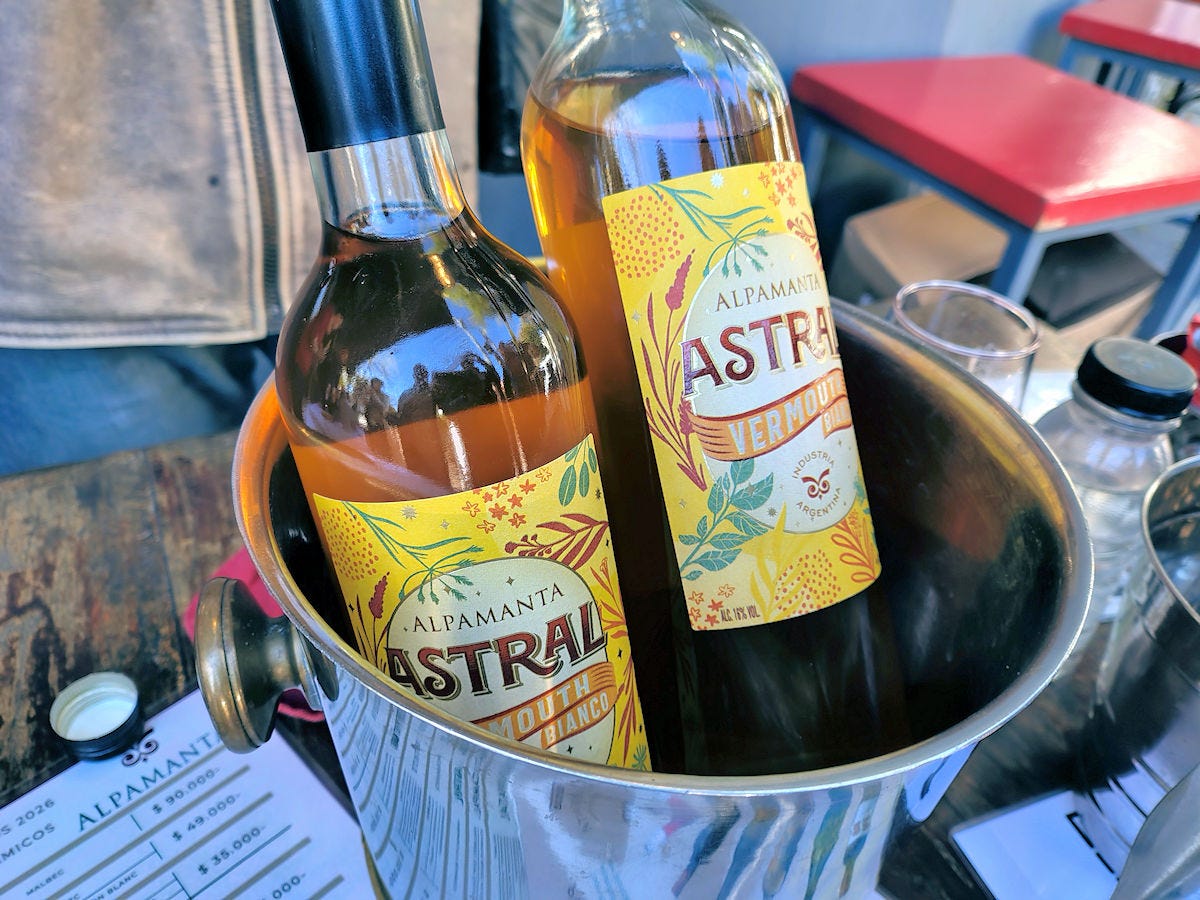
Alpamanta Astral
Founded in 2005 by a trio of European friends with the kind of ancestral wine pedigree that makes the rest of us feel distinctly middle-class, including cousins from the noble Austrian-Swiss Sayn-Wittgenstein family and a Frenchman whose family owns a Provence rosé estate, Bodega Alpamanta in Ugarteche, Mendoza, actually walks the walk when it comes to their “love for the land” moniker. The estate has achieved full, certified organic and biodynamic credentials, which they used to flex hard in May 2024 with the launch of Astral; Argentina’s first-ever certified organic and biodynamic vermouth. The production philosophy behind Astral borders on aggressive isolationism, relying on a zero-outsourcing model where every single input is traceable right back to the estate’s own soil. Built on a base of estate-grown Chardonnay and Sauvignon Blanc, it’s fortified with Alpamanta’s house-distilled brandy and sweetened with their own organic grape must. They then cram 12 distinct botanicals - wormwood, fennel, rosemary, basil, gentian, celery, curry, lavender flowers and leaves, melissa, olive, chili, and chañar (palo verde). A sweet white vermouth, I found this one to be very citrusy, which, interestingly, doesn’t seem to fit with any of the botanicals added, and probably comes from the wine itself. Lots of herbal notes. It didn’t wow me, but it was good. Runs around 20000 pesos a bottle.
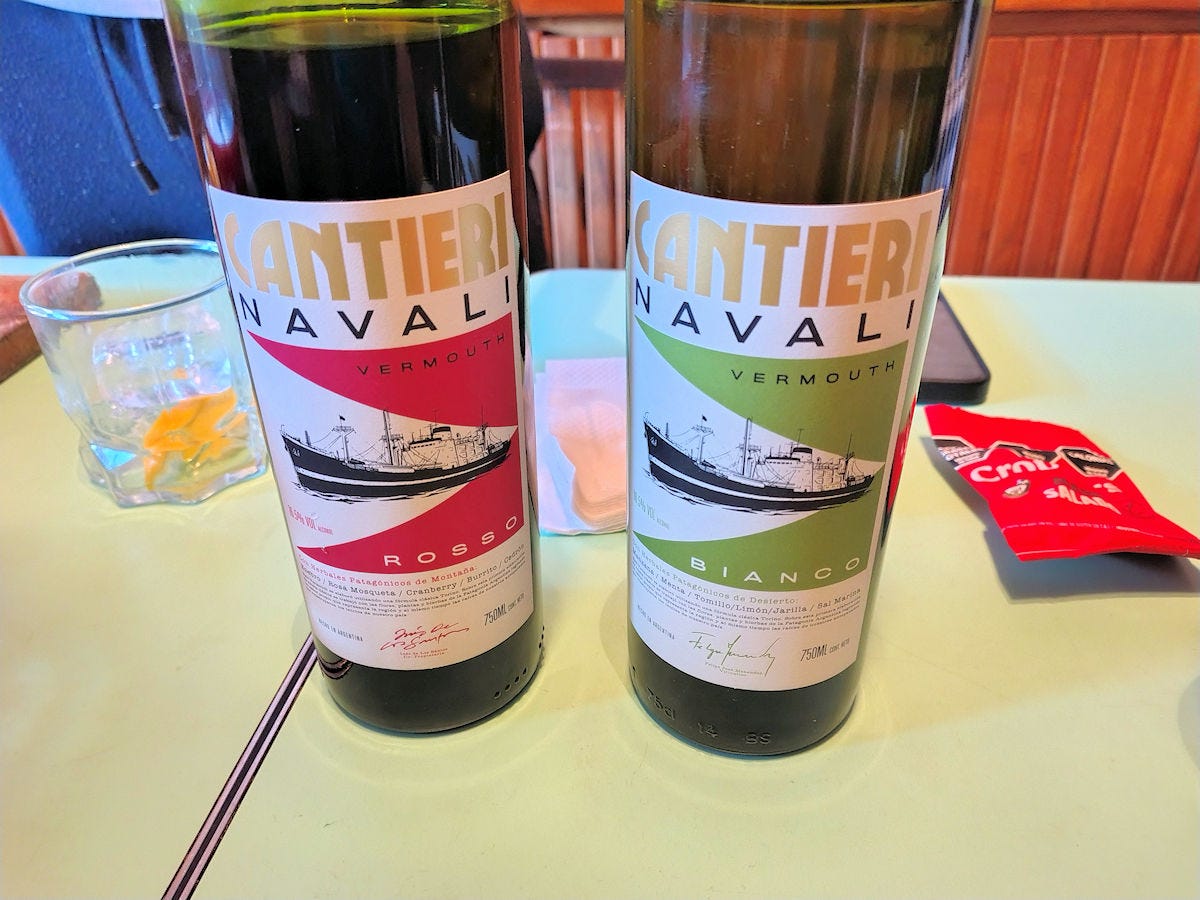
Cantieri Naval
Italian for “shipyard”, a project whose name manages to salute both Italy’s aperitivo obsession and co-founder Felipe Menéndez’s family history in the maritime shipping world. It’s a heavy-hitting collaboration between Menéndez, a Patagonian viticulturist from the Ribera del Cuarzo bodega, and Inés de los Santos, undisputed royalty in the Buenos Aires bar scene (co-owner of Cochinchina and partner in noted chef Narda Lepes’s Japanese venture Kona Corner). At least two years in development, their vermouths popped out in 2024. Both are built on a base of Sauvignon blanc from Patagonia, vinified in concrete tanks and rested for six months before release. Menéndez masterminded the Bianco to capture the “essence of the mountain,” resulting in a sweet lemon and mint tipple. De los Santos tackled the Rosso, channeling the “Patagonian desert” into an amber tinged red that’s actually drier than the white, with strong notes of star anise and cardamom. Both run 35000 pesos a bottle.
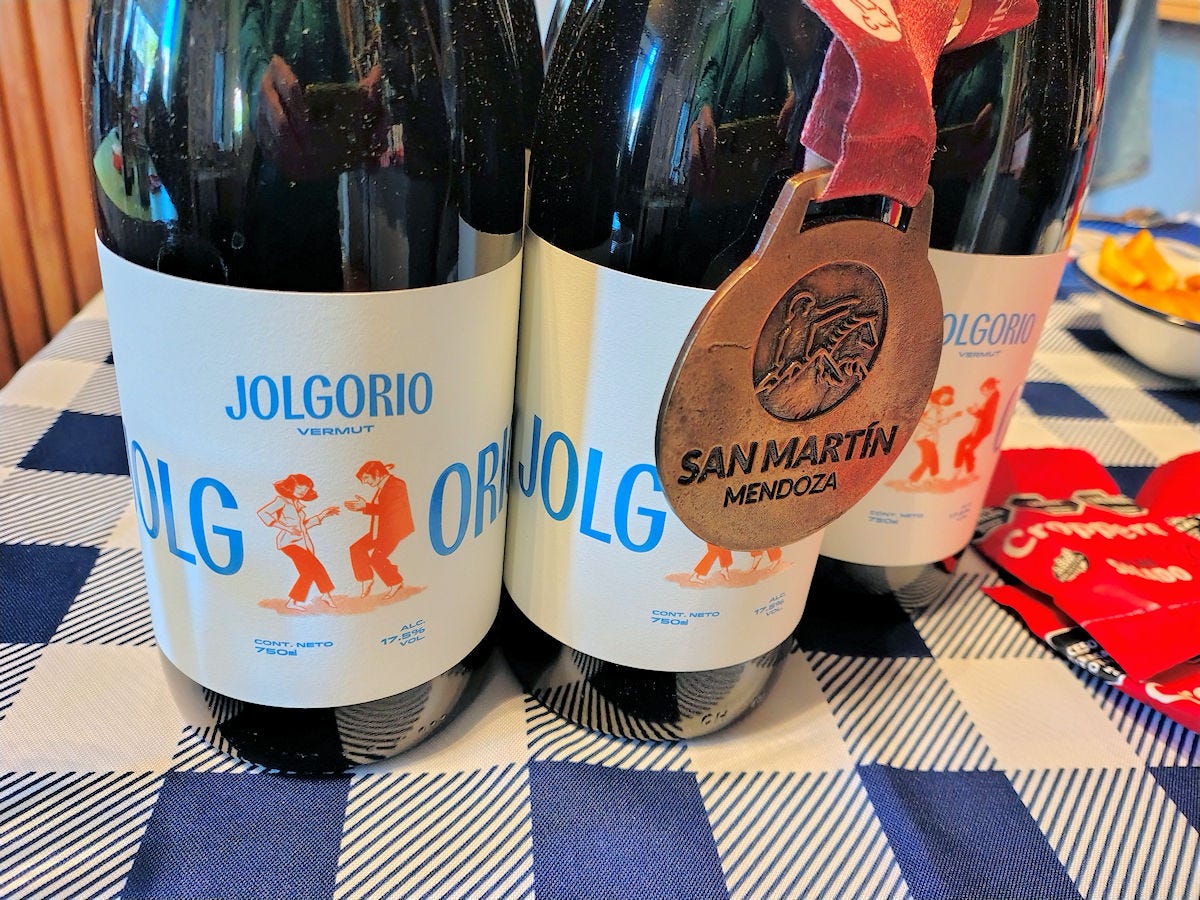
Jolgorio
A Mendoza vermouth project created by Alejandra "Ale" Martínez Audano and Denis Vicino, with production carried out at La Yunta Distillery. Jolgorio focuses on a single Rosso built on a base of Pedro Giménez, the primary grape of sherry. This white grape variety was long the unglamorous, blue-collar workhorse of Mendoza and San Juan before falling out of fashion, making its resurrection here a quietly nostalgic nod to Argentine wine heritage. They infuse the base with 11 botanicals, combining the mandatory wormwood with a lineup that reads suspiciously like a autumn charcuterie board: rosehip, plums, raisins, and walnuts. For me, the standout notes were cinnamon and tangerine - quite interesting. This one has prices all over the place, from 10000 to almost 30000 pesos a bottle - I can’t tell you why.
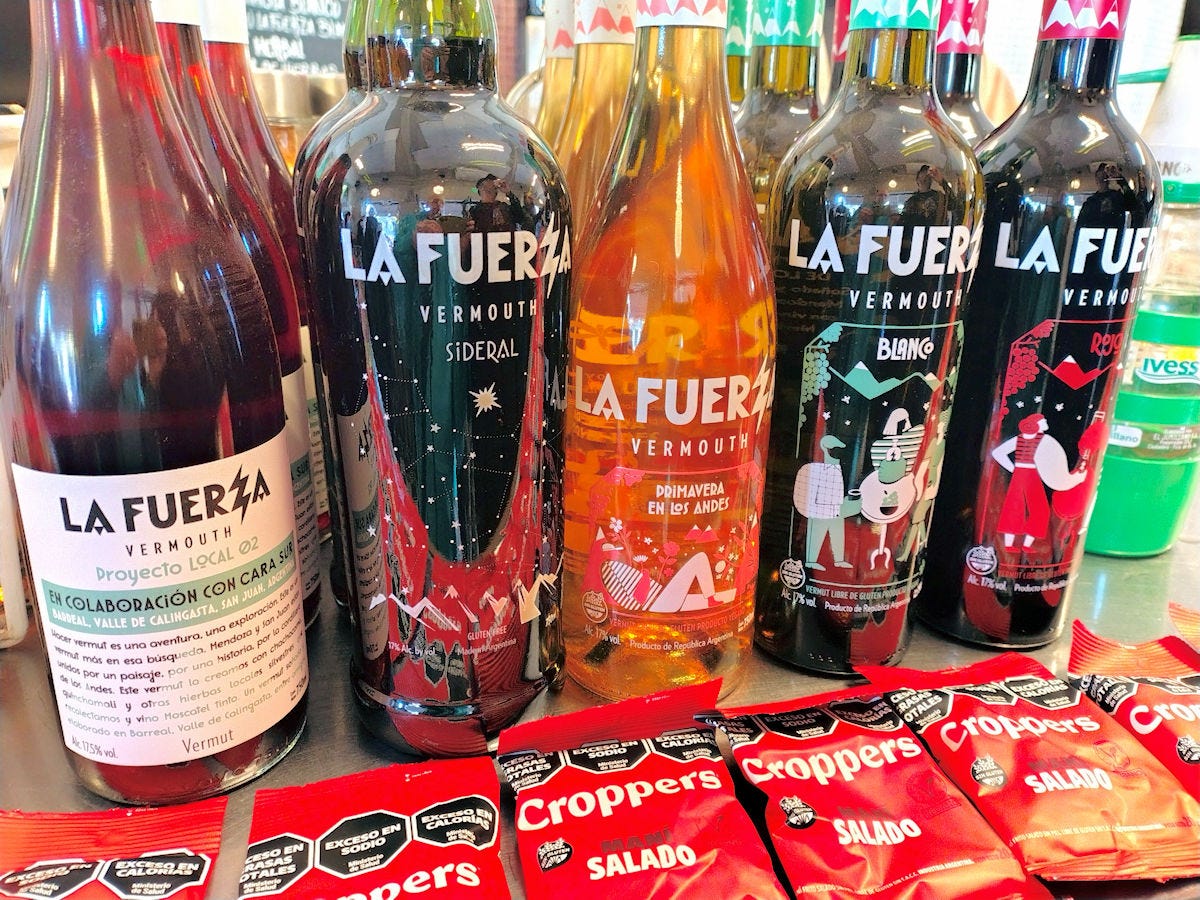
La Fuerza
And, finally, on to our hosts for the Vermutazo! event. They were offering a lineup of five vermouths. La Fuerza is the poster child of Argentina’s vermouth revival; the brand that kicked the door open for everyone else. Founded in 2016 by Julián Díaz, Agustín Camps, Sebastián Zuccardi, and Martín Auzmendi, it was a dream team: bar legend, marketing pro, winemaker royalty, and drinks journalist. Add Miguel Zuccardi, who trekked the Mendoza foothills drying wild herbs, and you’ve got a botanical Avengers assemble. Production happens at the Zuccardi winery, with Malbec and Torrontés as the main bases plus native botanicals; no preservatives, just grape must sweetness. Recognition came fast. Time magazine crowned La Fuerza Bar one of the World’s Greatest Places in 2019, and by 2024 Drinks International had them in the global Top 10 trending vermouth brands — the first Latin American name on the list.
Blanco - dry, with notes of anise and mixed herbs. Rosso - moderately sweet, with standout aromas of mint and dried fruits. Primavera en los Andes - very floral, and moderately sweet, I’ve always found this one a bit odd. New to me, Sideral - quite intense, with a sort of caramel, vanilla, and orange profile. And, also new, Proyecto Local 02 - very herbal and intense, limited production of just over 2000 bottles, apparently. The first three run around 20000 pesos, the other two around 25000 pesos, a bottle.
We’re at the end of the Vermutazo! tasting, or at least the part I saw (I’m still thinking there must have been an upstairs section that I just missed, but couldn’t have handled anyway). Based on responses via messages (you know, you can just comment right here on the post, you don’t have to communicate in private with me), it’s a topic of interest, so I’ll be posting more vermouths down the line.